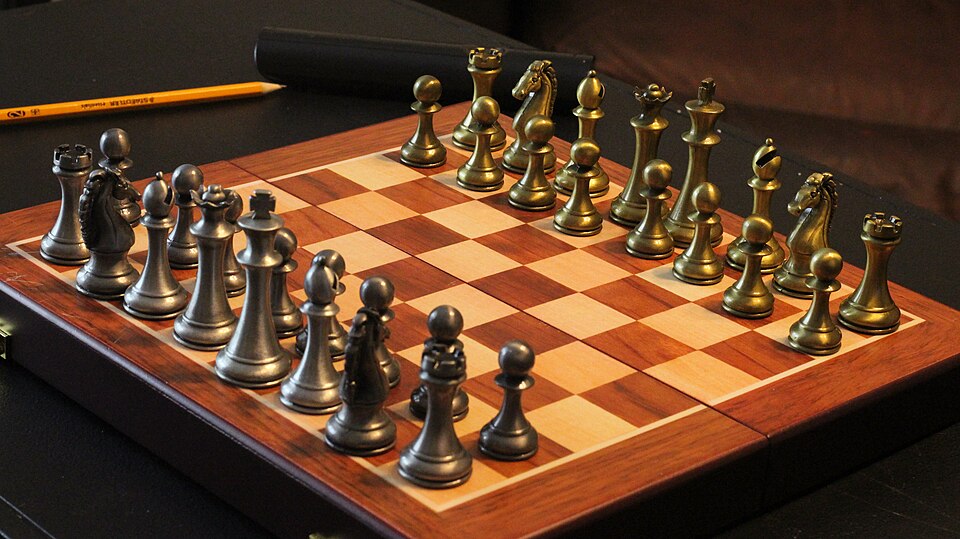
I’ve been playing chess in Clubhouse Games lately, and it made me want to make my own chess set.
I just like the feel of metal. The pieces you pick up would be metal, and the board would be wood. This article covers what I looked into to make that set, and how it might be made.

I don’t own or use any of the machines mentioned, and I haven’t made the pieces or the board yet. This is based on public sources checked on October 4, 2026 and on research for my earlier articles.
What to decide before making one
A chess set is easier to think about as two parts: the pieces and the board. For both, there are things to decide before choosing how to make them.
- Size: does it fit what the machine can make?
- Shape: cut it, build it up in layers, or pour it into a mould?
- Material: which metal for the pieces, which wood for the board?
There are three main ways to make metal pieces: cut them from a block of metal on a desktop CNC, build them up by melting powder in a metal 3D printer, or pour molten metal into a mould (casting). Each suits different sizes, shapes and materials, so I started with the size of the pieces and the board.
Size: standard sizes for pieces and board
Desktop CNCs and metal 3D printers both have a limit on how big a part they can make at once. For example, the SnowPod has a build volume of 80 × 80 × 100 mm, and the ToolDance X1 has 3-axis travel of 400 × 265 × 180 mm. To judge whether the pieces and board fit, I used the standard sizes that the International Chess Federation (FIDE) sets for tournaments.
| Piece | Standard height | Base diameter (40–50% of height) |
|---|---|---|
| King | 95 mm | 38–47.5 mm |
| Queen | 85 mm | 34–42.5 mm |
| Bishop | 70 mm | 28–35 mm |
| Knight | 60 mm | 24–30 mm |
| Rook | 55 mm | 22–27.5 mm |
| Pawn | 50 mm | 20–25 mm |
Source: FIDE, “Chess Equipment without Electronic Components” (effective March 1, 2026), section 6.3. Heights may vary by up to 10% as long as the order of heights is kept, and the base diameter should be 40–50% of the height. The base diameter column is calculated from that ratio.
For the board, section 3.3 of the same rules sets the side of a square at 5–6 cm and says four pawns should fit comfortably on one square. With 8 squares per row, the playing area alone is 40–48 cm square, and a frame around it makes it bigger still.
The rules also say a piece should not fall over when tilted about 30 degrees, and that pieces and board should have felt or a similar non-slip material underneath. Tournament pieces are meant to be wood, plastic or similar materials, so metal pieces are for playing and display at home.
Shape: round pieces and the knight need different methods
With the sizes known, shape is what decides the method. Chess pieces fall into two broad groups by shape.
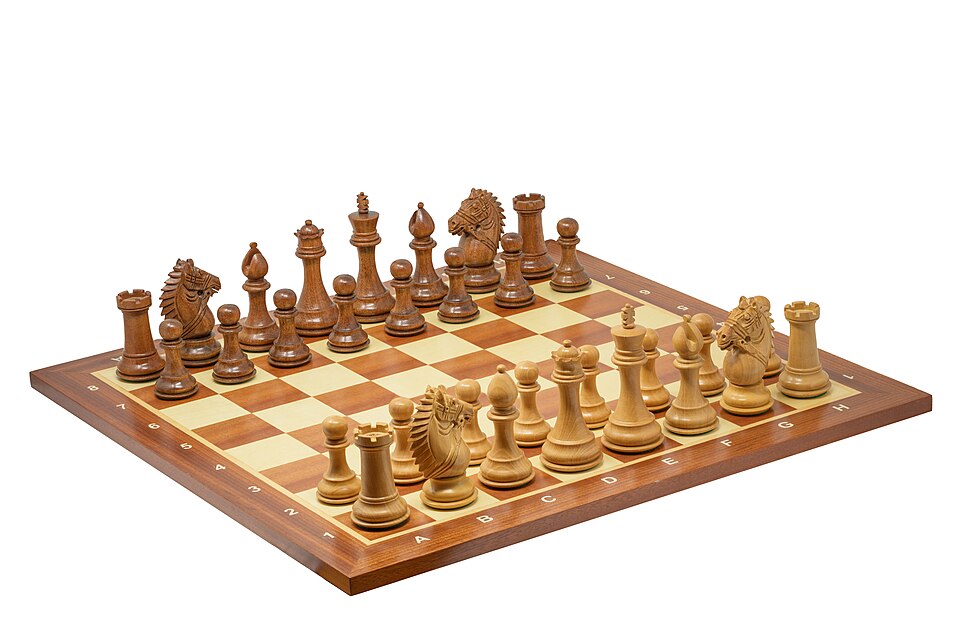

Round pieces suit cutting on a rotary axis
The bodies of the pawn, rook, bishop, queen and king are shapes turned around a central axis. Shapes like that suit cutting with the material mounted on a rotary axis and spun as it’s cut. I covered the difference between 4-axis and 5-axis in my guide to choosing a home CNC (Japanese) and my X1 article.
Some parts aren’t turned shapes, like the bishop’s slit or the king’s cross. For those, you stop the rotation, set the angle, and then cut. With only 3 axes and no rotary axis, you’d cut the front and back separately, re-clamping and re-aligning the part each time.
For the knight: 5-axis, a metal 3D printer, or casting
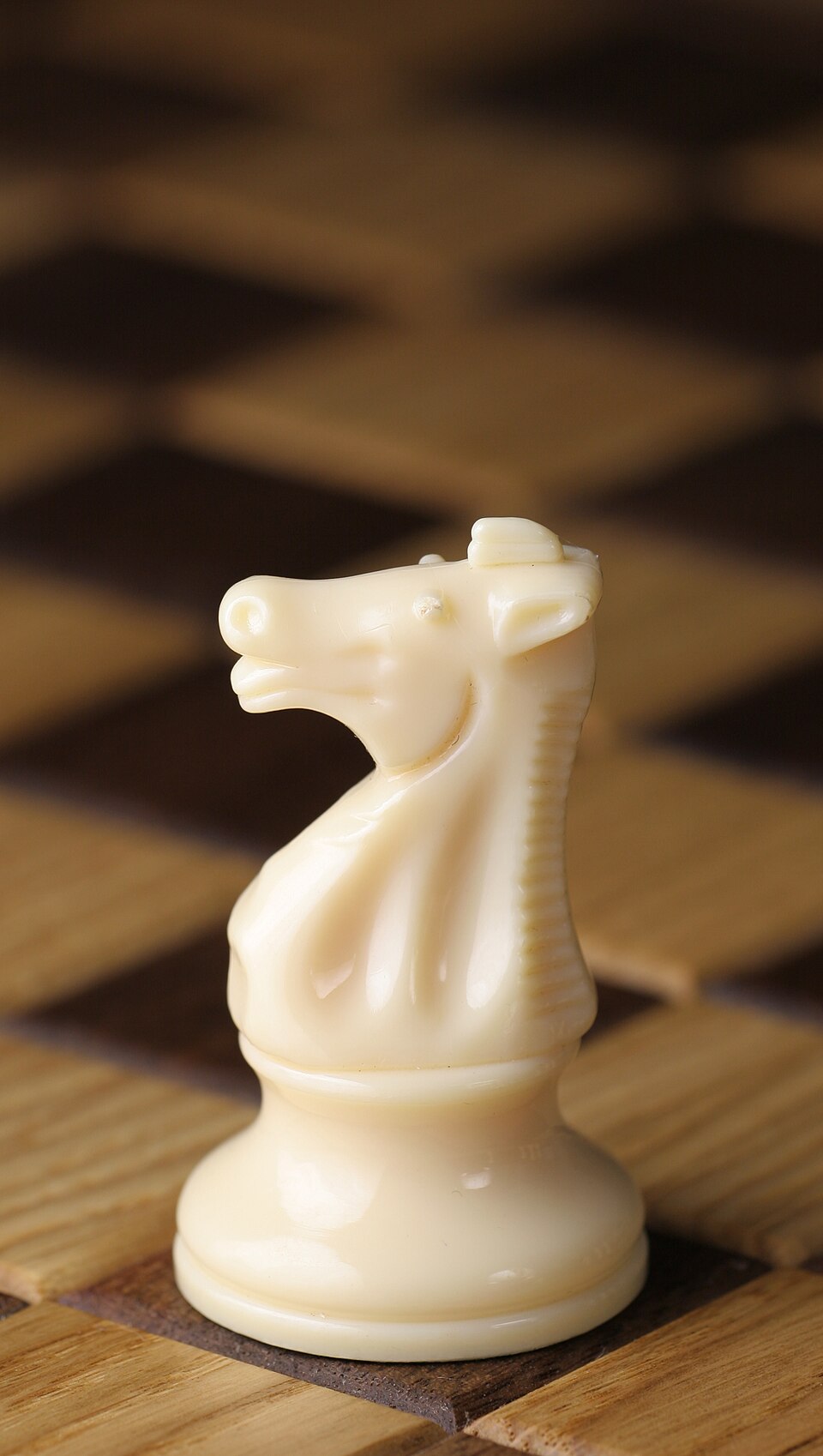

The knight’s horse head isn’t symmetrical, and it has faces pointing every which way. A tool cutting only from above can’t reach them all, so it suits 5-axis cutting that changes the angle as it goes, or another method entirely.
A metal 3D printer can build up shapes that are hard to cut. Layer lines and the work of removing supports remain, though.
Casting is another option. You surround a pattern shaped like the piece with a plaster-like material, burn the pattern out, and pour molten metal into the cavity left behind. If the pattern is 3D printed, even a shape like the knight can be turned into metal. Formlabs, known for its 3D printers, publishes a procedure for casting from patterns made in its castable resin. It says burning out the pattern needs heating to 732 °C or more, and lists an electric kiln (burnout furnace), a centrifugal or vacuum casting machine, ventilation and a dust mask as requirements. The metals it tested were gold, silver and bronze. Formlabs: casting procedure
Piece material: titanium or stainless steel?
The metals you can use depend on the method. Here are melting points and densities as a guide.
| Material (pure metal) | Melting point | Density |
|---|---|---|
| Titanium | 1670 °C | 4.506 g/cm³ |
| Iron | 1538 °C | 7.87 g/cm³ |
| Copper | 1084.62 °C | 8.96 g/cm³ |
| Aluminium | 660.323 °C | 2.70 g/cm³ |
Source: the Royal Society of Chemistry periodic table (titanium, iron, copper, aluminium). In practice you use alloys, so the values shift a little. Stainless steel is mostly iron, so its values are close to iron’s.
For the same shape, a titanium piece weighs about 60% of an iron (stainless steel) one (4.506 ÷ 7.87 ≈ 0.57), and aluminium about a third. Heavier pieces sit more steadily on the board, but FIDE only says pieces should be “easy to move and stable when placed”, so I’d like to find the right weight by making prototypes.
By method, it looks like this:
- Cutting (CNC): both titanium and stainless steel are options. ToolDance has published conditions for cutting Grade 5 titanium for over 60 minutes on the X1, and the TwoTrees ED1 and C500 also advertise titanium machining. Thin parts like the king’s cross or the knight’s ears depend on how far a small tool can go.
- Printing (SnowPod): the only material is 316L stainless steel. Titanium isn’t available.
- Pouring (casting): aluminium, or the bronze and silver that Formlabs tested. Titanium (1670 °C) and stainless steel (close to iron’s 1538 °C) melt at high temperatures, and I think pouring them with home equipment would be hard.
Board: made of wood
Even with metal pieces, I want the board to be wood. FIDE’s rules give examples of boards in natural wood, combining birch, maple or European ash with walnut, teak or beech. They also require the board to be flat without warping, the light and dark squares to contrast clearly, the surface to be matt and non-reflective, and non-slip material underneath. FIDE: boards (chapter 3)
In terms of size, the playing area alone is 40–48 cm square. The X1’s 3-axis travel is 400 × 265 mm and the TwoTrees ED1’s working area is 300 × 200 mm, so the board can’t be cut from a single piece. It will probably need to be made in squares or strips and glued together afterwards.
If you glue strips of light and dark wood side by side, slice across them, and offset alternate slices, you get a checkerboard. Strips and small parts fit within a CNC’s range, so the machine might handle getting the dimensions even. When I made the side of a keyboard from hinoki cypress, I had a hard time with the woodworking (Japanese), so the more I can leave to the machine, the easier it should be.
Matching methods to the set
Applying the size, shape and material above to the machines I’ve looked into, and to casting, gives this.
- SnowPod (printing)
- Size: build volume 80 × 80 × 100 mm. Every piece fits (the king has 5 mm of height to spare)
- Shape and material: suits shapes like the knight. Material is 316L stainless steel only
- ToolDance X1 (3-axis)
- Size: travel 400 × 265 × 180 mm. Plenty for the pieces, but the board can’t be cut in one piece
- Shape and material: cuts only from above, so parts need flipping. Titanium is an option
- ToolDance X1 (simultaneous 5-axis)
- Size: maximum workpiece 80 × 80 × 80 mm (in development). The 95 mm king and 85 mm queen don’t fit. Made 10% smaller, the queen (76.5 mm) fits but the king (85.5 mm) still doesn’t
- Shape and material: can cut both round pieces and the knight while changing the angle
- ToolDance X1 (3+2 machining)
- Size: maximum workpiece 80 × 114 × 92 mm (in development). The public materials don’t say which dimension is the height
- Shape and material: sets the angle, then cuts
- TwoTrees ED1
- Size: working area 300 × 200 × 120 mm. I couldn’t confirm the diameter and length of material the 4-axis can hold
- Shape and material: the 4-axis option can cut the round pieces. The knight has many faces at different angles
- NestWorks C500 (Japanese)
- Size: I couldn’t confirm the diameter and length of material the 4-axis can hold
- Shape and material: the simultaneous 4-axis module can cut the round pieces. The knight has many faces at different angles
- Casting
- Size: set by the flask that holds the mould and the size of the kiln. Unconfirmed, since I haven’t chosen equipment
- Shape and material: if you can make a pattern, the knight is possible too. Aluminium, bronze, silver and similar are options
The machine sizes are the official values cited in each article. In practice you need fixtures to hold the material, so what you can make is smaller than the published values.
The biggest catch is that the king doesn’t fit the X1’s simultaneous 5-axis range. To cut every piece on 5 axes, I’d have to make the king and queen a bit smaller, or make them another way.
How I’d like to make it
My current favourite is the ToolDance X1.
Still, the standard-size king and queen don’t fit the X1’s simultaneous 5-axis range. As for automatic toolpaths, the specs list 3-axis for parts and up to simultaneous 5-axis for relief and sculpted carving. Whether a knight can be made as carving, or needs other CAM software as a part, is something I still want to check.
Here’s where my thinking is now:
- Pieces: titanium or stainless steel, with the round pieces cut on a rotary axis. For the knight, compare 5-axis cutting with a metal 3D printer and casting. Work out a size for the king
- Board: light and dark wood. Gluing up strips is the leading idea, and I want to see whether a CNC can keep the dimensions even
What I want to check next
- What diameter and length of material the X1, C500 and ED1 rotary axes can hold
- Which dimension of the X1’s 3+2 maximum workpiece (80 × 114 × 92 mm) is the height
- How far a small tool can go in cutting the knight’s shape
- How heavy metal pieces are, and whether they stay up when tilted 30 degrees
- Which woods to combine for the board, and the steps for gluing up strips
- If I go with casting, the cost and space for a kiln and casting machine
I’ll add the answers to this article as I find them.