On 8 September 2026, Nikon announced that it is developing firmware Ver.2.00 for the Nikon ZR. It isn’t a new camera: it’s an update that adds features to the ZR people already own.
It’s been almost two months since the announcement, but as of 1 November it still hasn’t been released. The latest firmware on the ZR’s Download Center is Ver.1.11, from March 2026.
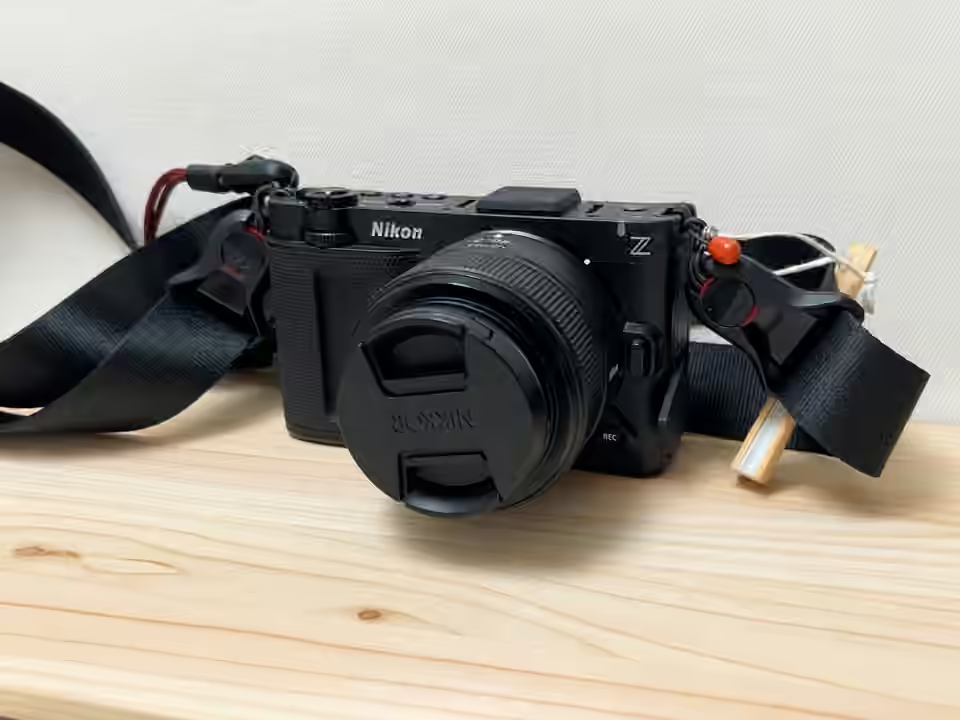
I bought the ZR myself and use it. Ver.2.00 isn’t out yet, so this isn’t a hands-on review: it’s Nikon’s announcement read from the side of someone who shoots with the ZR. Information checked on 1 November 2026.
When does Ver.2.00 arrive?
The first thing I wanted to know was when I could use it. Nikon’s announcement only says 2026, with no date.
When I checked the Download Center on 1 November, the latest ZR firmware was still C:Ver.1.11 (released 17 March 2026). I’ll add to this article once Ver.2.00 is out.
RED’s colour settings, now in H.265
Of the three, the one I think will matter most is being able to choose Log3G10 and REDWideGamutRGB in H.265.
The ZR already has R3D NE, a recording format that uses RED’s colour. It’s 12-bit RAW, and Nikon highlights more than 15 stops of dynamic range and footage that holds up even when you push the colour a long way. The files are big, though: a 1TB card holds about 35 minutes of 6K 60p. Straight out of the camera the colours look flat, so it assumes you’ll finish it in editing software such as DaVinci Resolve (Nikon’s R3D NE guide, Japanese).
H.265 is compressed video, so the same 1TB holds about 330 minutes of 5.4K 60p. Ver.2.00 lets you choose the same Log3G10 and REDWideGamutRGB as R3D NE in H.265 too. Nikon describes it as “compact file sizes with high color-grading latitude”.
You don’t want to deal with files as heavy as RAW, but you still want RED’s colour settings for your grade. With Ver.2.00, that becomes a way to shoot.
I normally shoot H.265 10-bit 5.4K 60p on a microSD card, because RAW formats such as R3D NE can’t be recorded to microSD (online manual). If RED’s colour settings work in H.265, I might be able to try them on the card I already have. Nikon hasn’t said yet whether they’ll work on microSD, so I’ll check once it’s out.
Still, H.265 doesn’t become RAW. Being able to choose the same colour settings is a separate question from how far you can push the colour and exposure. That won’t be clear until it’s out and someone shoots the same scene in R3D NE to compare. I’ve laid out how the two formats differ in R3D NE vs H.265.
Choosing how hard noise reduction works in the dark
The second feature matters if you shoot in low light. When you shoot H.265 in Log, you’ll be able to choose how strongly High ISO NR (noise reduction) works.
Strong noise reduction makes the image look clean, but it tends to wipe out fine texture along with the noise. Weaker settings keep the texture, and the grain with it. Nikon’s explanation is that you’ll be able to pick that balance to suit the look you want. It hasn’t said how many levels there will be or how strong each one is.
Focus peaking in R3D NE
The third is for people who focus by hand. Focus peaking colours the edges that are in focus. The announcement says peaking will be shown while recording in R3D NE.
If you mostly shoot with autofocus, I don’t think it changes much. If you shoot R3D NE with manual-focus lenses or cine lenses, it should make focusing much easier.
| Feature | Who it helps |
|---|---|
| Log3G10 / REDWideGamutRGB in H.265 | People who want to grade YouTube or travel videos too, and people for whom RAW files are too big |
| High ISO NR level in H.265 Log | People who shoot H.265 Log in the dark, at night or indoors |
| Focus peaking in R3D NE | People who shoot R3D NE with lenses they focus by hand |
Open Gate is planned for 2027
The announcement also covered Open Gate. It isn’t part of Ver.2.00, though.
The ZR’s sensor has the same 3:2 shape as a photo. Video today is a wide 16:9, so a strip at the top and bottom of the sensor goes unrecorded. Open Gate records the whole sensor, top and bottom included.
Where it pays off is when you crop a vertical video later. Crop a vertical frame out of 16:9 video and the height can only be as tall as the video. Record the whole sensor and, working it out from the ZR’s photo size, you get about 1.2 times the height. It becomes easier to make a horizontal YouTube video and a vertical Short from a single shoot.
The desqueeze display, planned alongside it, is for anamorphic lenses. These lenses are used to shoot wide, cinema-style footage: they squeeze the image horizontally when recording, and desqueeze stretches it back to its proper shape on screen.
Both are at the stage of “the goal of incorporating them in ZR firmware in 2027”, and resolution, frame rates and recording formats haven’t been announced.
On top of that, RED’s remote-control apps, RED CONTROL and RED CONTROL PRO, are being updated to support the ZR. On the same day, Nikon also announced it is developing nine NIKKOR Z CINEMA T1.9 VV cinema lenses, starting with a 50mm. Neither has a release date yet (lens announcement).
What I want to try once it’s out
When Ver.2.00 arrives, I plan to try these in my normal shooting:
- Whether H.265 Log3G10 records to my current microSD card
- How much the file size per minute changes
- The difference when I change the High ISO NR level in the dark
I’ll add what I find to this article and to R3D NE vs H.265. If you’re deciding whether to buy a ZR now based on the roadmap, I wrote about that in should you buy a Nikon ZR now?
References
- Nikon: Nikon is developing firmware version 2.00 for the Nikon ZR full-frame sensor camera (8 September 2026)
- Nikon: Nikon is developing nine cinema lenses in the NIKKOR Z CINEMA T1.9 VV series (8 September 2026)
- Nikon: ZR Download Center (checked 1 November)
- Nikon: ZR online manual, notes on video recording
- Nikon Japan: R3D NE shooting and editing guide (Japanese)
- Nikon Japan: choosing a recording format on the ZR (Japanese)